Gain Your Edge | #16
The Edge of Leadership Capacity — Where the System Breaks First

Organizations rarely fail because strategy is unclear. They begin to strain when leadership capacity becomes the limiting factor.
In sustained complexity, leaders often focus first on external pressures: market volatility, capital constraints, regulation, technology disruption, and stakeholder demands.
Those pressures are real. But the first internal fracture often appears elsewhere: the capacity of the leadership system to sustain judgment, decision quality, and execution under pressure.
Leadership capacity is not just talent or experience. It is the sustained ability to:
make sound decisions under uncertainty
hold competing priorities without fragmentation
regulate leadership energy across cycles
lead others without creating systemic depletion
When capacity is stretched too far, results may still look stable for a period. But strain usually surfaces later through slower decisions, avoidable errors, leadership churn, succession risk, or execution drift.
Why this matters now
Many organizations are operating under overlapping pressures:
AI-enabled acceleration and compressed decision cycles
transition risk and capital allocation tension
rising stakeholder scrutiny
workforce fatigue and capability gaps
In this environment, leadership capacity is not a soft issue. It is a strategic variable.
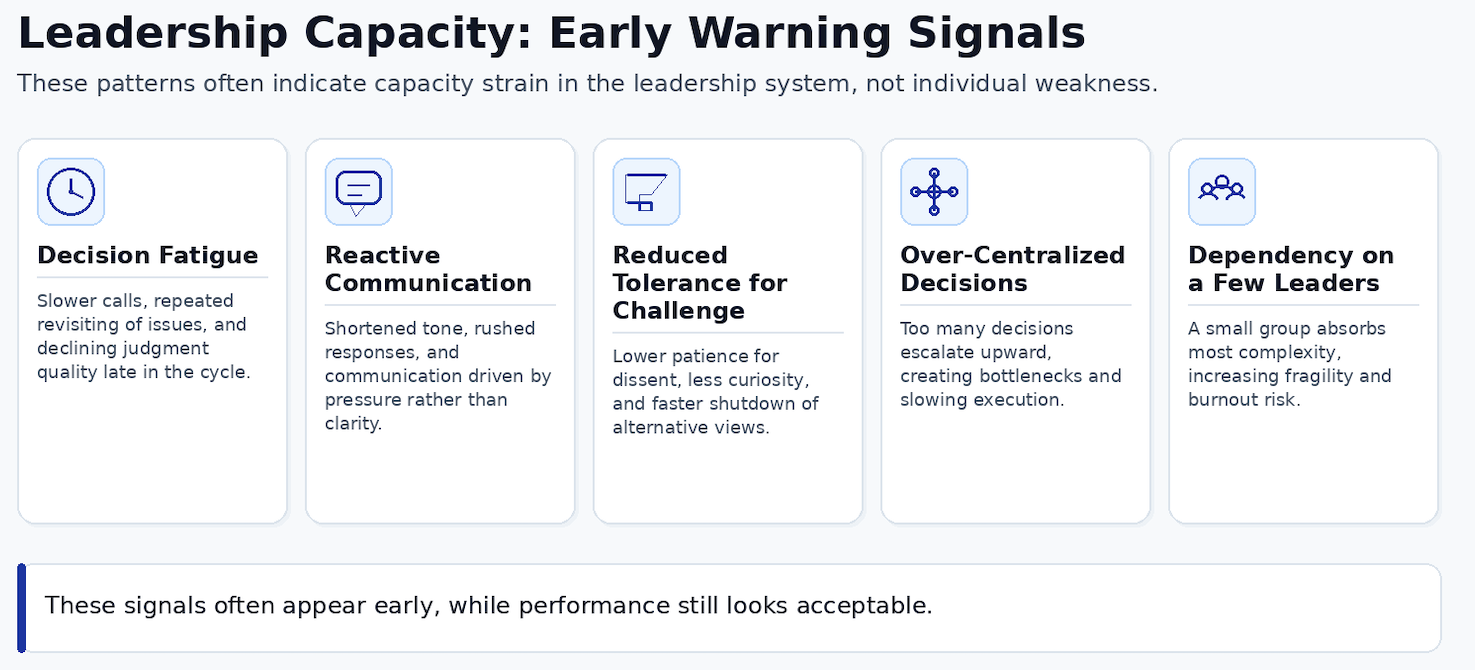
Common signals of strain include:
decision fatigue
reactive communication
reduced tolerance for challenge
over-centralization of authority
dependence on a few leaders to absorb complexity
These are not character flaws. They are system signals.
A board and CEO question worth asking
Boards and executive teams track performance, risk, and execution. Fewer explicitly ask whether leadership capacity is sufficient to sustain performance at the current pace.
Consider these questions:
Where are we over-dependent on a small number of decision-makers?
Which roles are carrying disproportionate complexity?
Where is succession depth thinner than current performance suggests?
What outcomes are being sustained by personal effort rather than system design?
Boards and CEOs who monitor leadership capacity early are better positioned to protect enterprise value and execution quality.
Final thought
Strategy sets direction. Governance provides clarity. Trust supports cohesion.
Leadership capacity determines how long the system can perform under pressure.
Instead of asking, Who needs to work harder? ask: What in the system needs redesigning?
That is the edge.
Mike Etuhoko, MBA, AccBD, GCB.D, CCB.D, ACC
Founder & CEO, Protekz Inc.
Sloan Fellow, London Business School
🔗 LinkedIn: https://www.linkedin.com/in/mike-etuhoko
