
Gain Your Edge | #30
Decision Quality Is a Leadership Discipline
Decisions are often treated as events.
A meeting is held.
Options are reviewed.
A recommendation is made.
Approval is given.
The organization moves on.
But in high-consequence environments, decisions are not isolated events.
They are the output of a leadership system.
That system includes the quality of information, the clarity of decision rights, the maturity of judgment, the discipline of challenge, the visibility of risk, and the accountability that follows.
When that system is weak, even smart leaders can make poor decisions.
This matters now because AI is changing the speed and volume of analysis. Leaders can access more information, generate scenarios faster, and surface patterns that were harder to see before.
That is useful.
But faster information does not guarantee better choices.
AI may improve analysis, but it does not replace judgment. It does not carry accountability. It does not resolve competing priorities. It does not determine what level of risk the organization should accept. It does not decide when a technically attractive option is strategically wrong.
Those responsibilities still sit with leaders.
Last week, I wrote about the hidden cost of leadership fragmentation. When strategy, governance, operations, and leadership behaviour stop reinforcing one another, execution begins to drift.
Decision quality is one of the disciplines that reconnects the system.
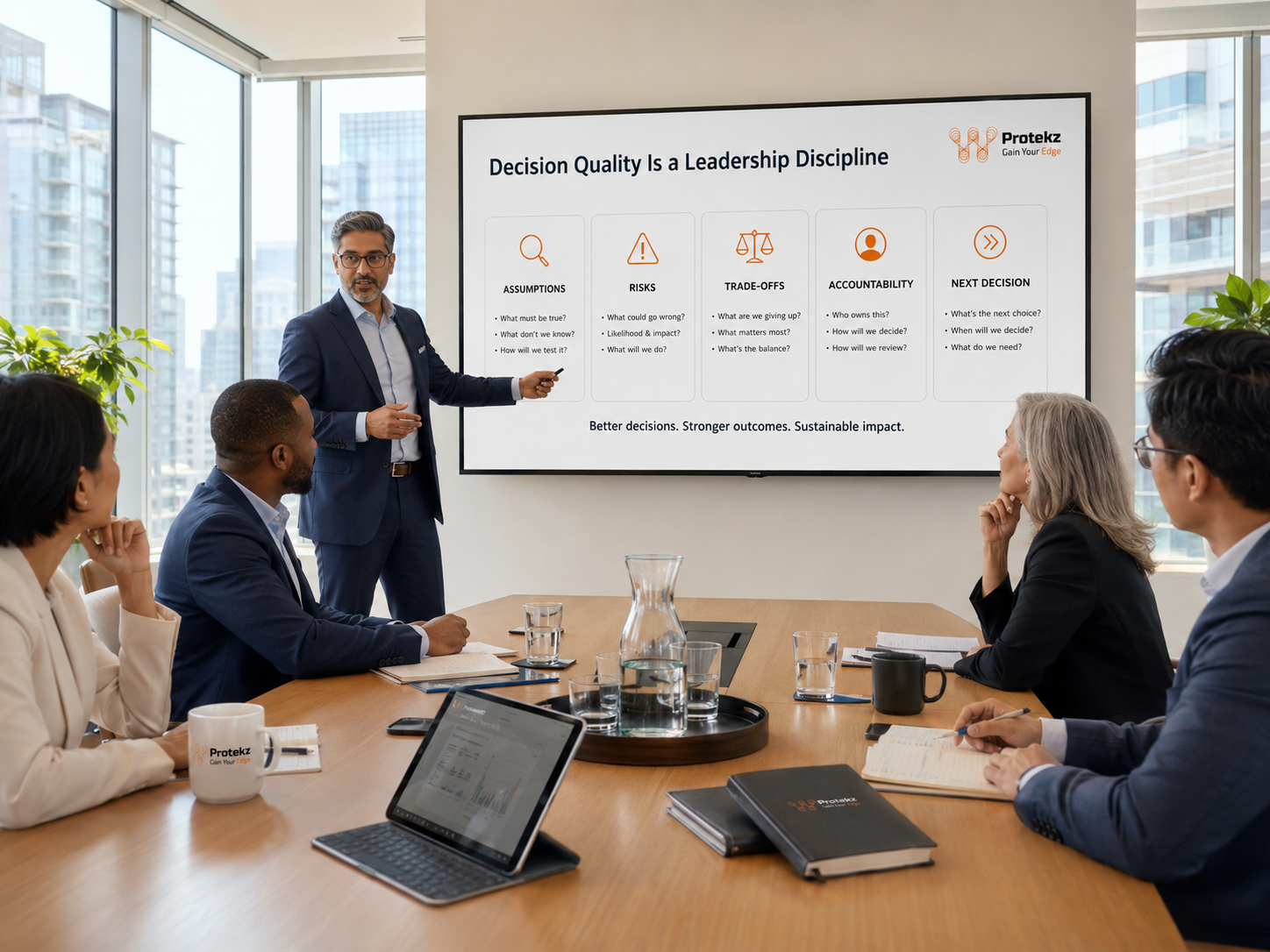
It forces leaders to ask better questions before choices become commitments.
Who owns this decision?
What assumptions are we relying on?
What risks are we accepting?
Who has been heard, and who has not?
What trade-offs are we making explicit?
What would cause us to revisit this decision?
These questions slow the room just enough to improve the outcome.

For boards, decision quality is not only about approving the right recommendation. It is about understanding whether management used the right process to reach it.
For CEOs and executive teams, it is about creating conditions where truth travels quickly, challenge is welcomed, and accountability is clear before execution begins.
The leadership risk is not that organizations lack data.
The deeper risk is that they mistake more data for better judgment.
In an AI-enabled world, this distinction will matter even more.
The organizations that win will not simply be those with faster analytics. They will be those with stronger decision discipline.
The board-level question this week is:
Which decisions in our organization require better process discipline, not simply more data?
Because decision quality is not a technical exercise.
It is a leadership discipline.
Mike Etuhoko, MBA, AccBD, GCB.D, CCB.D, ACC
Founder & CEO, Protekz Inc.
Sloan Fellow, London Business School
🔗 LinkedIn: https://www.linkedin.com/in/mike-etuhoko
