Gain Your Edge | #21
The Edge of Risk Architecture — Risk Is Not the Enemy. Blind Spots Are
“The most damaging risks are rarely the ones organizations identify. They are the ones they fail to see in time.”

In boardrooms and executive teams, risk is often treated as a control issue.
Something to monitor, mitigate, and report.
But in volatile environments, that is too narrow.
Risk is also a leadership issue.
It is about how well an organization sees, interprets, and responds to uncertainty before it becomes loss.
This is where risk architecture matters.
Risk architecture is not a register or a quarterly review.
It is the system that helps an organization detect weak signals, test assumptions, and respond early enough to protect strategy and enterprise value.
Why Conventional Risk Approaches Fall Short
Many organizations still manage risk as a compliance exercise.
Known risks are logged.
Owners are assigned.
Reports move upward.
That discipline matters, but it often lags reality.
Boards and senior executives now face overlapping pressures:
AI and technology disruption
geopolitical and regulatory volatility
energy transition uncertainty
capital allocation tension
reputational scrutiny
These risks do not stay separate.
They interact.
A cyber issue can become a trust issue.
A regulatory shift can reshape investment choices.
A reputational event can quickly become a governance problem.
By the time risk appears clearly in a formal report, damage may already be building.
Risk architecture helps organizations see sooner.
What Risk Architecture Requires
Strong risk architecture starts with a better question:
Where are we most likely to be blindsided?
Organizations that do this well usually do three things:
Expand visibility
They look beyond operational and financial risk to strategic, technological, and external shifts.
Create room for challenge
Blind spots grow when assumptions go untested.
Connect risk to strategy
Risk does not sit beside strategy.
It sits inside it.
When this architecture is strong, leaders see earlier and act with greater discipline.
The Board’s Role in Risk Architecture
Boards do more than review reports.
They test the assumptions behind strategy.
Effective boards ask:
What assumptions are carrying our strategy?
Where is the business model most fragile?
What signals may not be reaching us early enough?
Which risks are we carrying by choice, and which by neglect?
These are not just oversight questions.
They are questions of judgment and resilience.
Risk and Strategy Are Not Opposites
Growth carries risk.
Innovation carries risk.
Transformation carries risk.
The question is not whether risk exists.
The question is whether leadership sees it clearly enough to act with conviction.
Strong organizations do not avoid risk altogether.
They engage it consciously, challenge assumptions early, and reduce the chance that hidden vulnerabilities become expensive surprises.
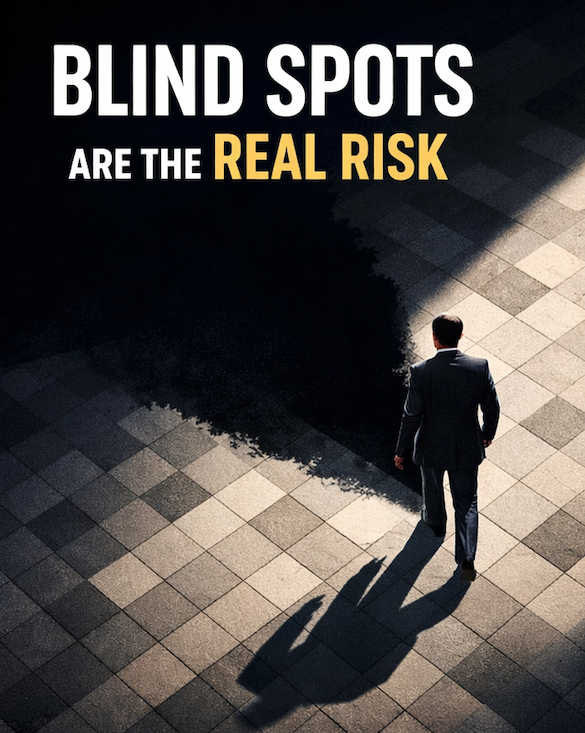
The Blind Spot Check
In your next board or executive discussion, ask:
What are we assuming will remain true?
What weak signals might we be missing?
What information may be getting softened before it reaches the top?
Are we rewarding candour and challenge?
These questions will not remove uncertainty.
But they will improve visibility.
And better visibility often makes the difference between resilience and regret.
Final Thought
Risk is not the enemy.
Blind spots are.
Organizations that see earlier, challenge harder, and respond faster do not just manage uncertainty better.
They lead through it.
That is the edge.
Mike Etuhoko, MBA, AccBD, GCB.D, CCB.D, ACC
Founder & CEO, Protekz Inc.
Sloan Fellow, London Business School
🔗 LinkedIn: https://www.linkedin.com/in/mike-etuhoko
