Gain Your Edge | #26
The Edge of Institutional Endurance — Building Organizations That Outlast Leaders
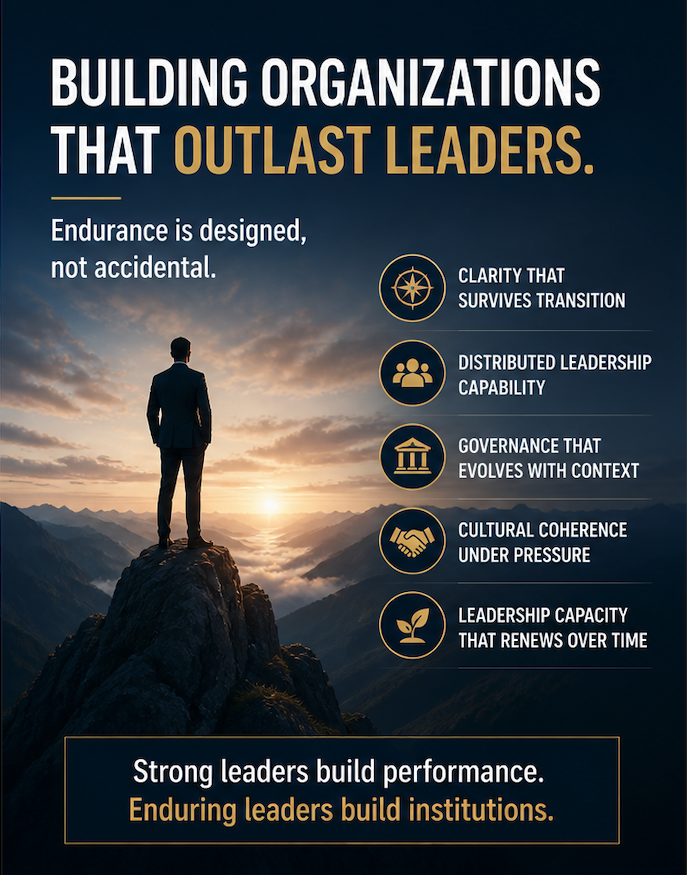
“Strong leaders build performance. Enduring leaders build institutions.”
Most organizations can deliver strong results for a period.
Fewer can sustain performance across cycles, leadership transitions, and shifting environments.
That difference is not luck.
It is design.
Institutional endurance is the ability of an organization to perform, adapt, and remain trusted over time — independent of any single leader.
Why Endurance Is Now a Strategic Priority
The pace and persistence of change have altered what “success” looks like.
Energy systems are being reconfigured.
AI is reshaping operating models.
Stakeholder expectations continue to rise.
Capital flows are increasingly tied to credibility and resilience.
In this environment, short bursts of performance are no longer sufficient.
Organizations are being tested on their ability to:
sustain results under prolonged pressure
transition leadership without disruption
adapt strategy without losing identity
maintain trust across cycles
Endurance is no longer a by-product of success.
It is a requirement.
What Distinguishes Enduring Enterprises
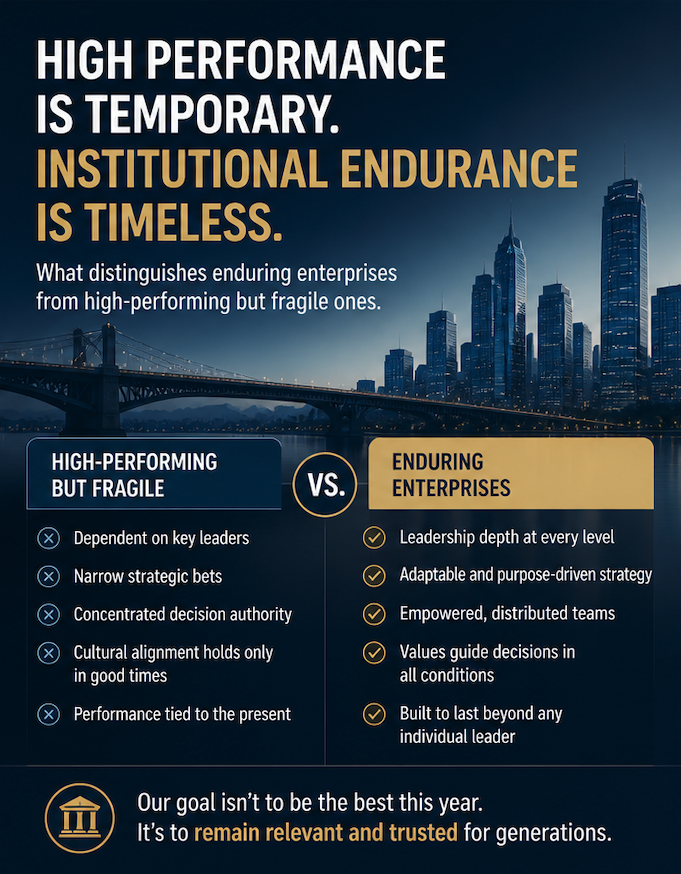
High-performing but fragile organizations often depend on:
a small number of strong leaders
narrow strategic bets
concentrated decision authority
cultural alignment that holds only under stable conditions
These organizations can excel, until conditions shift.
Enduring enterprises are designed differently. They build:
Clarity that survives transition
Purpose, priorities, and decision principles are understood beyond the executive layer.
Distributed leadership capability
Judgment and ownership are developed across levels, not concentrated at the top.
Governance that evolves with context
Oversight adapts as risks, technologies, and stakeholder expectations change.
Cultural coherence under pressure
Values are not only stated — they guide behavior when trade-offs are real.
Leadership capacity that renews over time
Systems are designed to prevent depletion and sustain performance across cycles.
Endurance is not about resisting change.
It is about absorbing it without losing direction.
The Board’s Role in Institutional Strength
Boards are uniquely positioned to shape endurance.
Beyond overseeing quarterly performance, effective boards focus on:
leadership succession and bench strength
alignment between strategy, capital allocation, and stated values
governance structures that support clarity and adaptability
early signals of cultural or capacity strain
They ask questions that extend beyond the current leadership cycle:
Will this organization perform as strongly without today’s leaders?
Are we building systems or relying on individuals?
What must remain steady as strategy evolves?
Endurance is built when governance looks beyond immediate outcomes.
From Performance to Continuity
There is a natural tension between delivering results now and building for the future.
Organizations that prioritize only near-term performance often:
defer capability development
delay difficult structural decisions
rely on existing leadership capacity until it strains
Those that invest in continuity:
build leadership depth early
align incentives with long-term value
design systems that function beyond individual tenure
Continuity is not the absence of performance pressure.
It is the discipline of balancing it with long-term intent.
Final Thought
Performance can be achieved.
Endurance must be built.
The organizations that matter most over time are not those that peak the highest. They are those that remain strong when leadership, markets, and conditions inevitably change.
That is the edge.
Mike Etuhoko, MBA, AccBD, GCB.D, CCB.D, ACC
Founder & CEO, Protekz Inc.
Sloan Fellow, London Business School
🔗 LinkedIn: https://www.linkedin.com/in/mike-etuhoko
