
Gain Your Edge | #25
The Edge of Stakeholder Value Integration
“Stakeholders don’t judge what you report. They judge what your decisions reveal.”
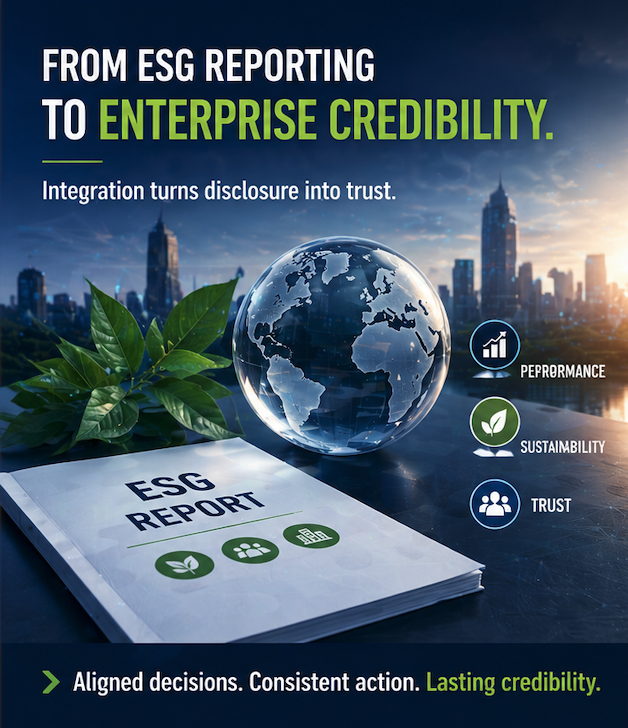
Over the past decade, ESG has moved from the margins to the mainstream. Most organizations now publish sustainability reports, track metrics, and communicate commitments.
Yet a gap remains.
Many organizations report responsibly — but are not yet seen as credible.
Credibility is not built through disclosure alone.
It is built through integration.
Why ESG Reporting Is No Longer Enough
Reporting has improved transparency. It has not guaranteed alignment.
Stakeholders today — investors, regulators, employees, and communities — are asking more demanding questions:
Do capital allocation decisions reflect stated sustainability priorities?
Are trade-offs acknowledged openly — or avoided?
Does leadership behavior reinforce or contradict reported commitments?
In other words, the focus has shifted from what organizations say
to how consistently they act.
This is where stakeholder value integration becomes critical.
What Integration Actually Means
Integration is not about adding ESG to strategy. It is about embedding it into how strategy is executed.
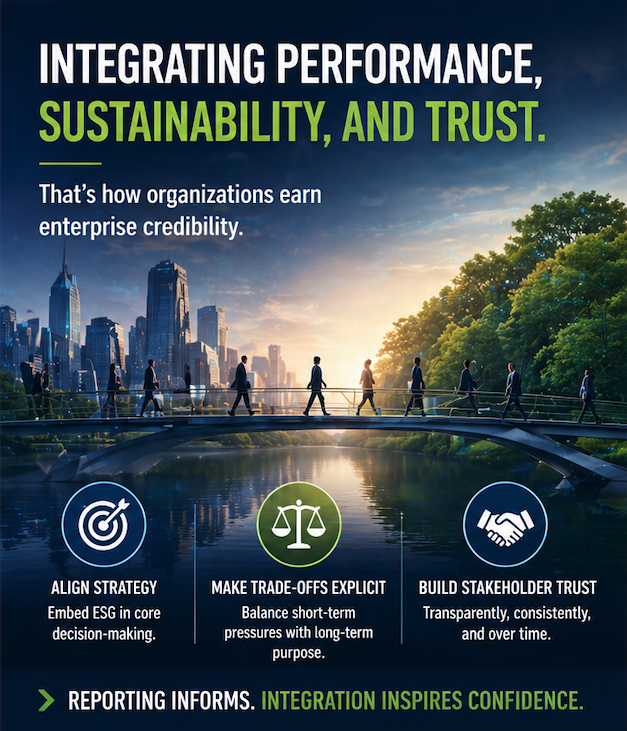
Organizations that move beyond reporting typically align three elements:
Performance
Clear delivery of financial and operational results.
Sustainability
Consideration of environmental and social impact in decisions.
Trust
Consistent, transparent engagement with stakeholders — especially when trade-offs are difficult.
When these three are aligned, credibility strengthens. When they are disconnected, skepticism grows.
Integration turns ESG from a reporting exercise into a leadership discipline.
The Board’s Role in Credibility
Boards play a decisive role in whether ESG becomes integrated or remains peripheral.
Effective boards do not treat ESG as a separate agenda item.
They ensure it is reflected in:
capital allocation decisions
risk oversight discussions
executive incentives
strategic priorities
They ask questions such as:
Where are we making trade-offs between performance and sustainability — and are they explicit?
Do our investment decisions reinforce our stated commitments?
How do we maintain stakeholder trust when priorities conflict?
Credibility is strengthened when governance aligns decisions with intent.
Navigating Trade-Offs with Clarity
Integration does not eliminate tension. It makes it more visible.
There will be moments when:
cost discipline conflicts with environmental commitments
growth ambitions challenge social expectations
short-term performance pressures test long-term positioning
In these moments, credibility depends less on the outcome —
and more on how decisions are made and communicated.
Leaders who:
acknowledge trade-offs openly
explain the rationale behind decisions
and act consistently over time
build trust even when not all stakeholders agree.
Final Thought
Reporting informs stakeholders. Integration convinces them.
Organizations that align performance, sustainability, and trust do more than meet expectations.
They earn the confidence to lead through complexity.
That is the edge.
Mike Etuhoko, MBA, AccBD, GCB.D, CCB.D, ACC
Founder & CEO, Protekz Inc.
Sloan Fellow, London Business School
🔗 LinkedIn: https://www.linkedin.com/in/mike-etuhoko
