Gain Your Edge | #41
BOARD BRIEF
Risk Architecture Is a Value-Creation System
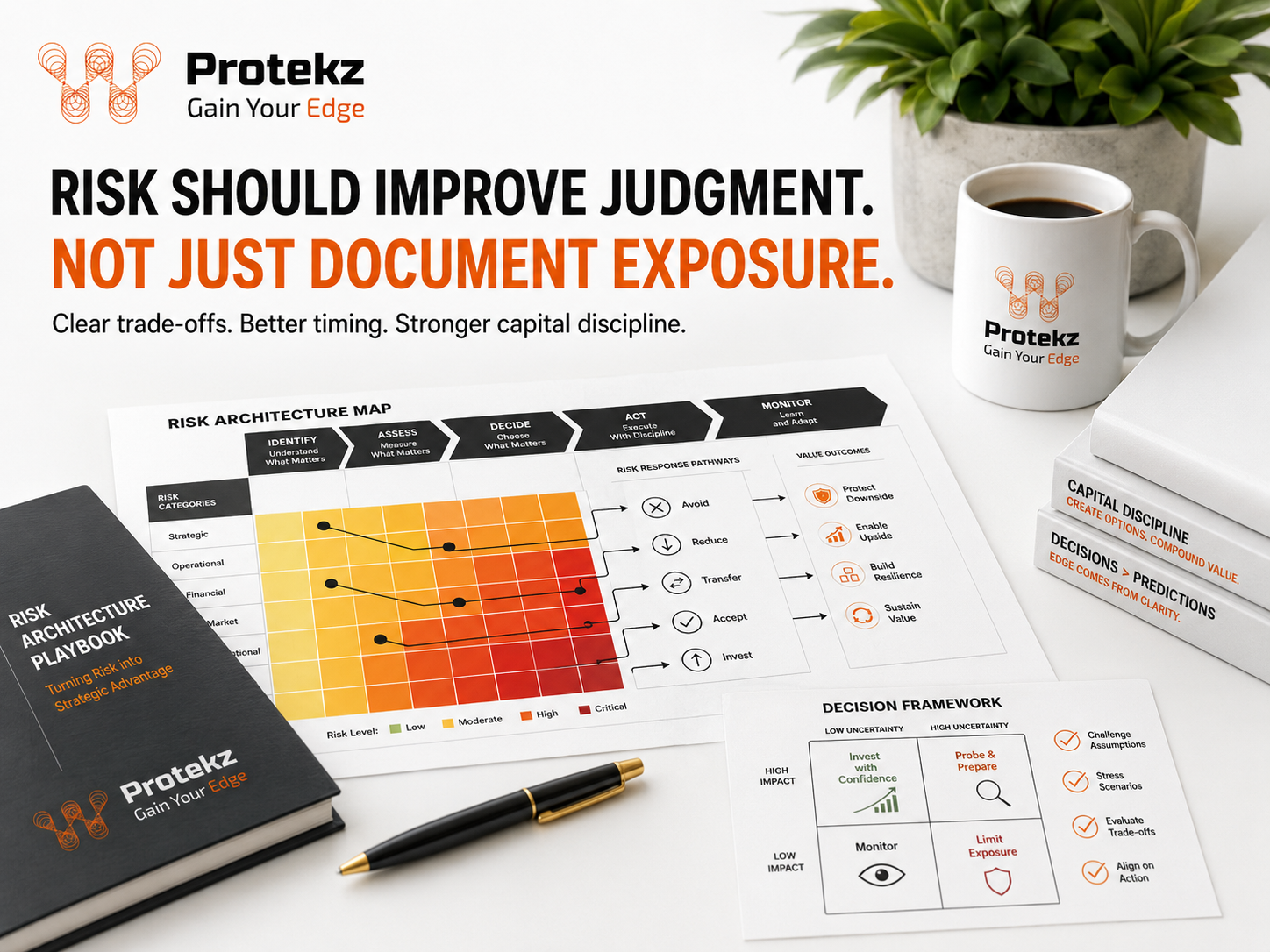
Risk management is often treated as a defensive function.
Identify threats.
Document controls.
Reduce exposure.
Protect the organization from downside.
That work matters.
But it is not enough.
In high-consequence environments, risk management should not only help leaders avoid failure. It should help them make better strategic choices.
That is where risk architecture becomes a value-creation system.
A weak risk system does more than expose the organization to harm. It delays opportunity. It weakens confidence. It distorts capital choices. It causes leaders to either overreact, underreact, or wait too long for clarity that may never arrive.
Last week, I wrote about capital discipline under competing futures. The central point was that capital decisions now require scenario discipline, because the future is not simply unclear. It is contested.
This week goes one layer deeper.
Capital discipline depends on risk architecture.
If risk is only documented after decisions are shaped, it becomes a compliance exercise. If risk is surfaced early, tested honestly, and connected to strategy, it becomes a decision advantage.
The question is not whether the organization has a risk register.
The stronger question is whether the risk system improves judgment.
Does it clarify trade-offs?
Does it expose weak assumptions?
Does it distinguish material risk from noise?
Does it help leaders understand when to move, pause, adapt, or exit?
Does it connect risk appetite to real capital decisions?

For boards, this is a governance issue. Oversight is not simply asking whether risks are being managed. It is asking whether the organization’s risk architecture is helping management make sharper choices under uncertainty.
For CEOs and executive teams, risk should not sit beside strategy. It should inform strategy. It should help leaders see where value is vulnerable, where opportunity is constrained, and where disciplined risk-taking may be necessary.
The strongest organizations do not use risk management only to prevent loss.
They use it to improve timing, strengthen confidence, protect optionality, and allocate capital with greater discipline.
The board-level question this week is:
Does our risk system help us decide, or mainly help us document?
Because risk architecture is not only about protection.
Properly designed, it is a system for better judgment, stronger choices, and more durable value.
