Gain Your Edge | #38
AI Speed and Governance Lag
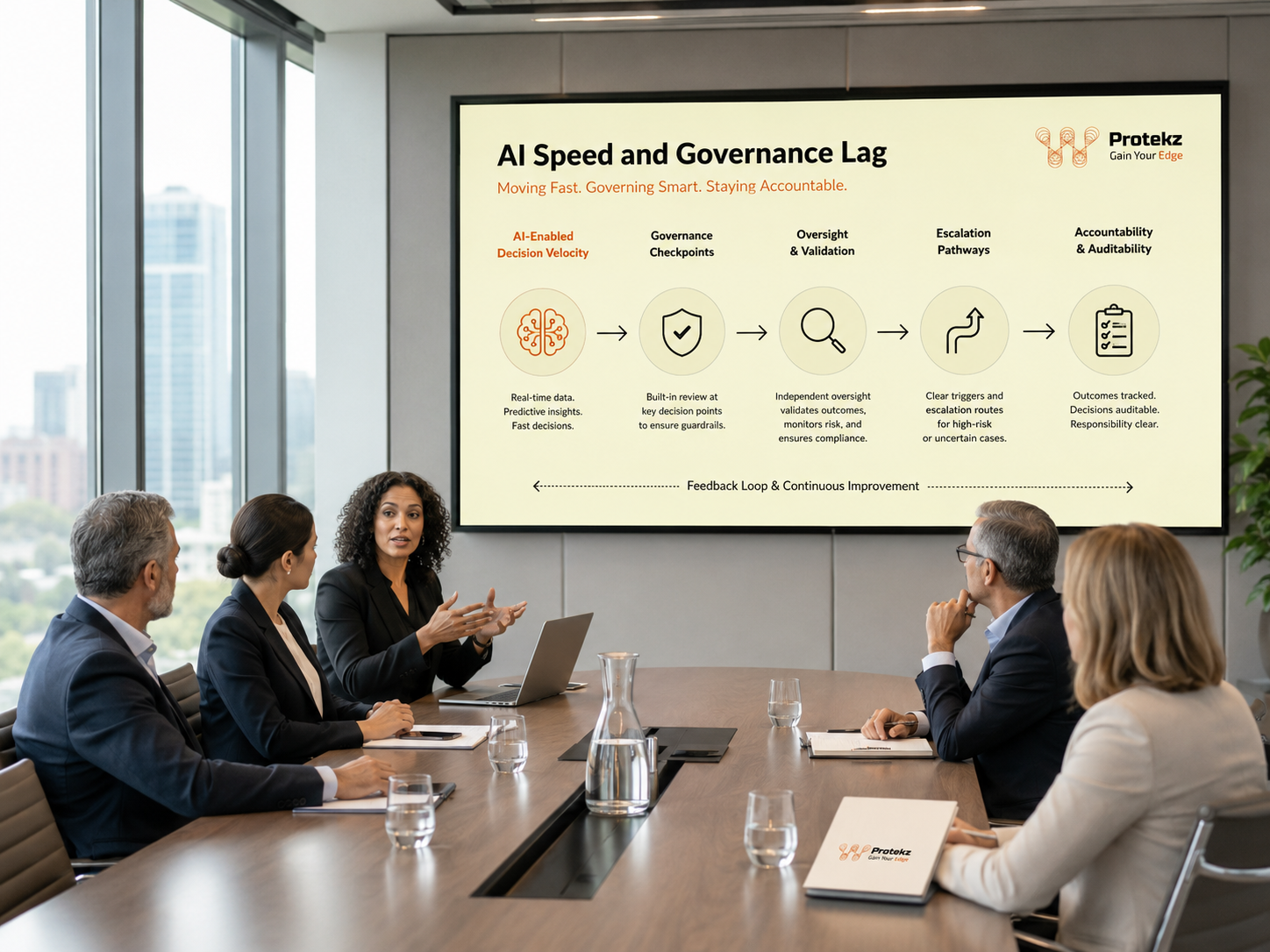
AI is compressing the time between analysis and action.
What once took days can now take hours.
What once required several teams can now be produced by one person with the right tools.
Scenarios can be generated faster.
Reports can be summarized instantly.
Patterns can be detected earlier.
Recommendations can appear with greater confidence and speed.
That creates opportunity.
It also creates a governance problem.
Most governance systems were designed for slower information flows. They assume time for review, escalation, challenge, documentation, and approval. But AI-enabled work does not always move at that pace.
This creates a dangerous gap.
Technology adoption accelerates.
Governance maturity lags.
Decisions move faster than oversight.
Risk becomes visible after the process has already shaped the outcome.
That is the challenge of AI speed and governance lag.
Last week, I wrote about the boundary between human judgment and machine output. AI can inform, recommend, rank, detect, and accelerate. But accountability must remain visible.
This week goes to the next issue.
Can governance keep pace without becoming either reactive or restrictive?
If governance is too slow, it becomes a bottleneck. Leaders bypass it, innovation moves elsewhere, and value is delayed.
If governance is too loose, it becomes symbolic. AI enters decision pathways without sufficient challenge, risk visibility, or accountability.
Neither position is good enough.
Boards and executives need a more intelligent governance rhythm.
Not control after the fact.
Not approval of every tool.
Not policy without operating discipline.
The real task is to understand where AI is increasing decision velocity, where that velocity creates exposure, and where governance must become more adaptive.
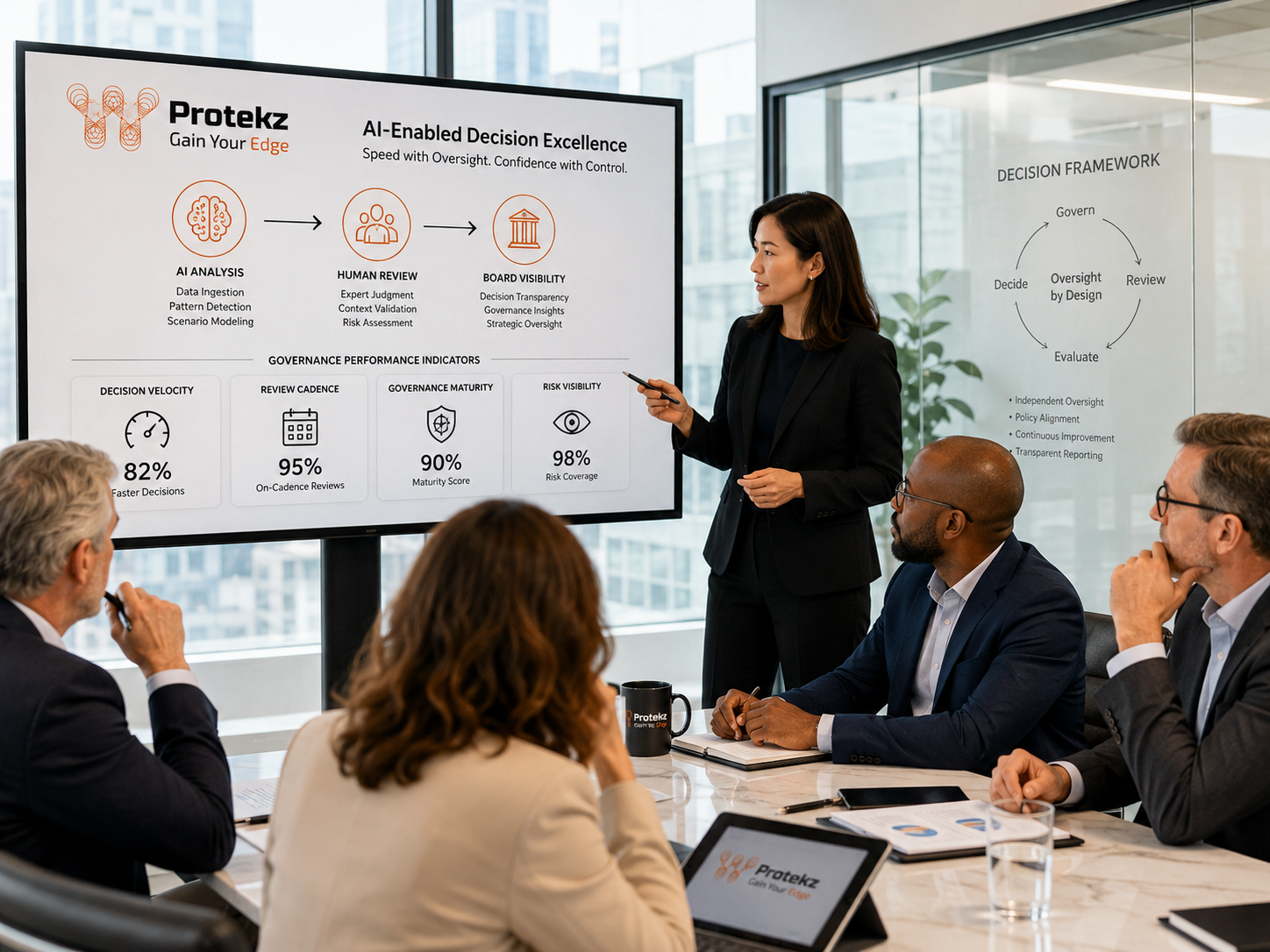
For boards, the question is not only, “Are we using AI responsibly?”
It is, “Can our governance model see fast enough, challenge early enough, and intervene wisely enough?”
For CEOs and executive teams, the issue is practical. AI may improve productivity, but productivity gains can become governance risk if decision rights, accountability, escalation, and review mechanisms are unclear.
The strongest organizations will not slow AI down unnecessarily.
They will strengthen the system around it.
They will clarify where AI can accelerate decisions, where human judgment must pause the process, and where board visibility is required before speed becomes exposure.
The board-level question this week is:
Where is our organization moving faster than our governance model can intelligently oversee?
Because the risk is not speed itself.
The risk is speed without governance maturity.
Mike Etuhoko, MBA, AccBD, GCB.D, CCB.D, ACC
Founder & CEO, Protekz Inc.
Sloan Fellow, London Business School
🔗 LinkedIn: https://www.linkedin.com/in/mike-etuhoko
