
Gain Your Edge | #23
The Edge of AI Governance — Governing Intelligence Without Losing Humanity
“Technology expands capability. Governance preserves responsibility.”
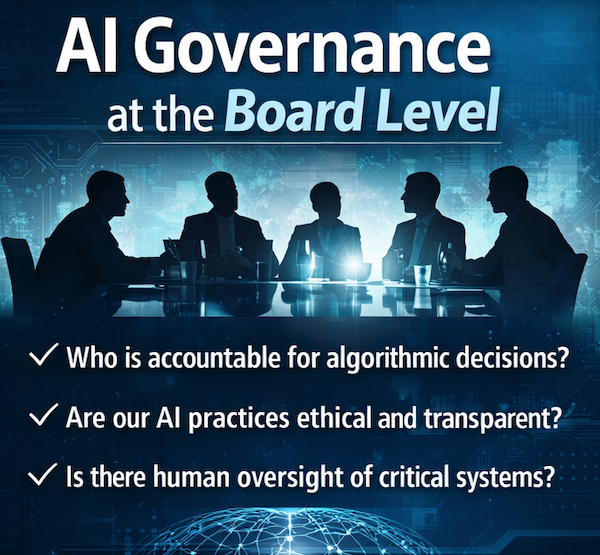
Artificial intelligence is rapidly becoming embedded in the operating systems of modern enterprises. From predictive analytics and operational automation to decision support and customer engagement, AI is reshaping how organizations function.
Yet as capability expands, so does responsibility.
For boards and senior executives, the central question is no longer whether AI will be adopted. That moment has already passed. The real question is:
How do we govern intelligence without losing the human judgment that sustains trust and accountability?
This is where AI governance becomes a leadership issue — not simply a technical one.
Why AI Governance Is Now a Board-Level Responsibility
AI introduces a different category of risk and opportunity than previous technological shifts.
Algorithms influence decisions at speed and scale.
Data flows across systems and jurisdictions.
Models evolve continuously through learning processes.
These characteristics create new governance considerations:
Who is accountable when automated decisions produce unintended consequences?
How transparent are the models influencing critical outcomes?
How do organizations ensure ethical use of data and algorithms?
How do leaders balance efficiency gains with societal expectations of fairness and responsibility?
Boards increasingly recognize that AI is not just a tool deployed by management.
It is becoming an operating infrastructure that shapes enterprise behavior.
Governance must evolve accordingly.
Governing AI Is Not the Same as Managing Technology
One of the most common governance mistakes is to treat AI purely as an IT issue.
Technical oversight matters, but AI governance sits at the intersection of several leadership domains:
Strategy
How AI changes competitive advantage, productivity, and industry structure.
Risk
How algorithmic decisions introduce operational, reputational, and regulatory exposure.
Ethics and trust
How stakeholders perceive fairness, transparency, and responsibility.
Leadership judgment
How humans remain accountable for decisions influenced by intelligent systems.
In other words, AI governance is less about controlling technology and more about preserving human accountability within technological systems.
What Effective Board Oversight Looks Like
Boards do not need to become technical experts to govern AI effectively.
What they must do is ask disciplined questions that ensure oversight remains aligned with enterprise values and risk appetite.
Examples include:
Where is AI currently influencing critical decisions within the organization?
What governance structures ensure transparency and auditability of models?
How are ethical considerations integrated into AI deployment decisions?
Who ultimately owns accountability when automated systems shape outcomes?
These questions reinforce a fundamental principle:
AI may support decision-making, but responsibility remains human.
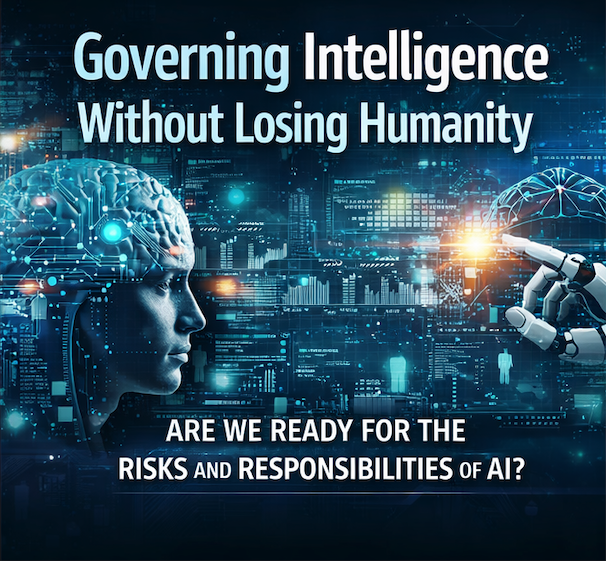
Balancing Innovation with Responsibility
AI creates extraordinary opportunities for efficiency, innovation, and insight.
But it also introduces pressures that can tempt organizations to prioritize speed over reflection.
Strong governance ensures that innovation does not outpace judgment.
Organizations that succeed in this balance typically:
establish clear accountability for AI-enabled decisions
integrate ethical considerations early in development
maintain transparency with stakeholders about how AI is used
and ensure leadership remains actively engaged in oversight
Innovation and responsibility are not opposing forces.
When governed well, they reinforce each other.
Final Thought
Artificial intelligence may transform how organizations operate.
But trust, accountability, and judgment will always remain human responsibilities.
The challenge for leaders and boards is simple to state, and complex to practice:
Harness intelligence without surrendering humanity.
That is the edge.
Mike Etuhoko, MBA, AccBD, GCB.D, CCB.D, ACC
Founder & CEO, Protekz Inc.
Sloan Fellow, London Business School
🔗 LinkedIn: https://www.linkedin.com/in/mike-etuhoko
