
Gain Your Edge | #24
The Edge of Cultural Coherence — Alignment at Scale
“Culture is not what is written. It is what is repeated — especially when pressure rises.”
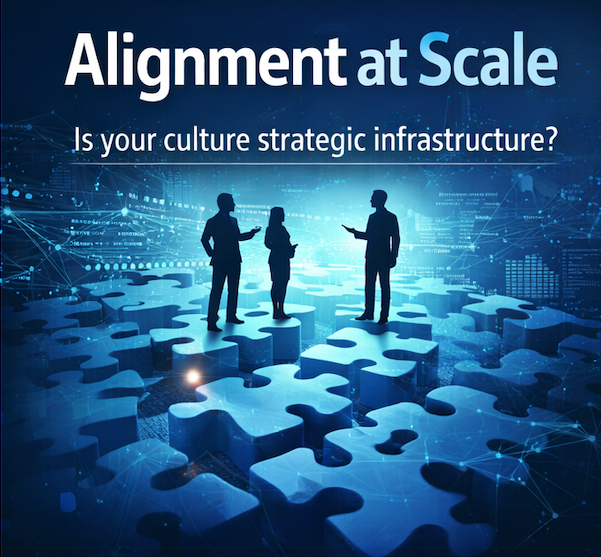
As organizations grow, diversify, and operate across geographies, functions, and technologies, one challenge becomes increasingly visible:
How do you maintain alignment at scale?
Strategy can be defined. Structures can be redesigned. Systems can be installed. But without cultural coherence, execution fragments.
Cultural coherence is what allows an organization to move as one, even as complexity rises.
Why culture must be treated as infrastructure
Culture is often treated as soft. It is not. It behaves more like infrastructure.
It shapes how decisions are interpreted, how teams respond under pressure, how consistently strategy is executed, and how trust is built or lost.
When culture is coherent, alignment travels faster. When it is not, leaders spend their time correcting drift.
At scale, misalignment is rarely a communication problem. More often, it is a design problem.
What cultural coherence really means
Cultural coherence does not mean sameness. It means consistency of interpretation.
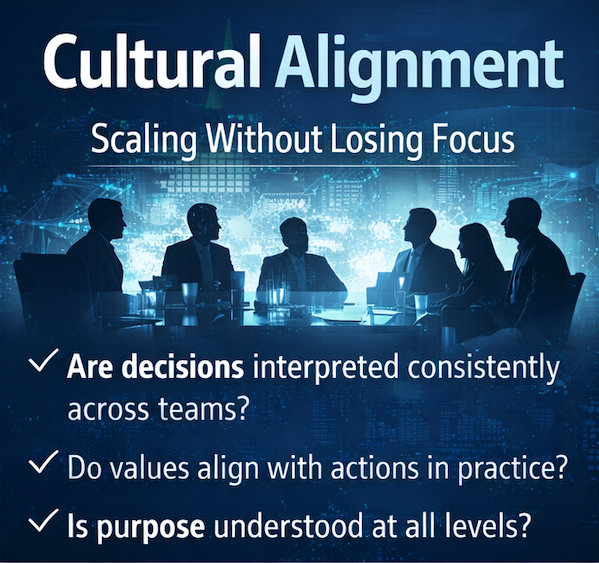
People across the organization should understand what matters most, how decisions get made, what behaviors are expected under pressure, and how trade-offs are handled when priorities collide.
That clarity allows teams to act with autonomy without losing alignment.
Without it, strategy gets interpreted differently, accountability becomes uneven, and execution slows because alignment has to be rebuilt again and again.
Coherence creates speed without surrendering control.
The role of leadership and boards
Culture is shaped less by formal statements and more by repeated signals.
What leaders reinforce, what they tolerate, what they reward, and how they respond when results fall short all shape the culture that actually scales.
When those signals are inconsistent, culture fragments. When they are steady, culture holds.
Boards matter here. They help ensure that values show up in strategic choices, capital allocation, leadership behavior, and risk oversight.
Culture becomes infrastructure when it is governed with intention.
Alignment without over-control
Scaling always creates tension between alignment and autonomy.
Too little alignment leads to fragmentation. Too much control creates rigidity.
Cultural coherence sits in the middle. It supports decentralized decisions, faster execution, and a more consistent stakeholder experience because the principles guiding action are clear.
Leaders do not need to control every decision. They need to ensure decisions are made within a shared frame.
Final thought
Strategy sets direction. Governance provides clarity. Culture enables execution at scale.
When culture is coherent, organizations do not just operate. They move with intent.
That is the edge.
Mike Etuhoko, MBA, AccBD, GCB.D, CCB.D, ACC
Founder & CEO, Protekz Inc.
Sloan Fellow, London Business School
🔗 LinkedIn: https://www.linkedin.com/in/mike-etuhoko
